Introduction: Why System Design Interviews Matter More Than Ever
System design interviews have become the make-or-break round for mid-level to senior engineering positions at top tech companies. While you might breeze through LeetCode challenges, many talented engineers find themselves stuck when asked to "design Instagram's feed" or "build a URL shortener at scale."
Here's the uncomfortable truth: watching courses doesn't prepare you for the pressure of a live system design interview.
In 2026, companies are placing even more weight on architectural thinking. Why? Because AI tools like Copilot and ChatGPT can generate code, but they can't make high-stakes architectural decisions about scalability, reliability, and cost trade-offs.
This guide will show you exactly how to prepare for system design interviews—from understanding what interviewers are really testing to creating a practice plan that actually works.
What Are System Design Interviews Really Testing?
Before diving into preparation strategies, you need to understand what interviewers are looking for. System design interviews aren't about memorizing solutions—they're about demonstrating architectural judgment.
The Four Core Skills Being Evaluated
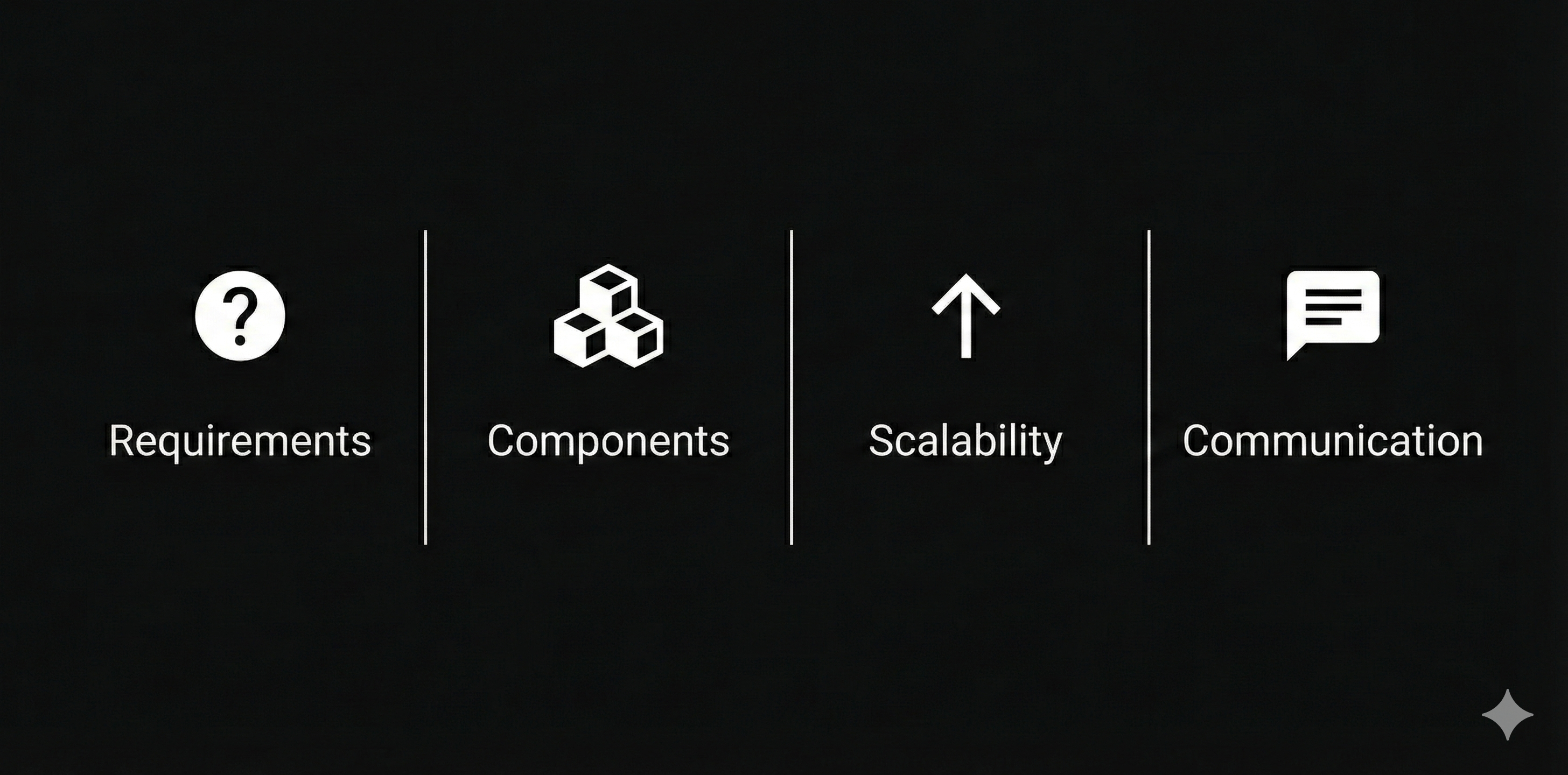
1. Requirements Clarification
- Can you ask the right questions about scale, latency, and consistency?
- Do you understand functional vs. non-functional requirements?
- Can you identify constraints and make explicit trade-offs?
2. Component Design
- Do you know when to use different databases (SQL vs. NoSQL)?
- Can you explain caching strategies and their trade-offs?
- Do you understand load balancing, message queues, and CDNs?
3. Scalability Thinking
- Can you design systems that handle millions of users?
- Do you understand horizontal vs. vertical scaling?
- Can you identify bottlenecks and propose solutions?
4. Communication & Trade-offs
- Can you explain your decisions clearly?
- Do you acknowledge trade-offs rather than claiming "best" solutions?
- Can you adapt your design based on interviewer feedback?
What they're NOT testing:
- Your ability to memorize "the correct answer" to "Design Twitter"
- Deep knowledge of every database or cloud service
- Perfect solutions (they don't exist)
Common System Design Interview Questions in 2026
While every company has its own style, certain patterns emerge repeatedly. Here are the most common categories:
URL Shortening & Link Services
- "Design bit.ly"
- "Design a URL shortener that handles 100M requests/day"
Why it's common: Tests data modeling, hashing, and caching
Social Media Feeds
- "Design Instagram's photo feed"
- "Design Twitter's timeline"
- "Design Facebook's news feed ranking algorithm"
Why it's common: Tests fan-out patterns, caching, and real-time updates
Ride-Sharing & Location Services
- "Design Uber's driver matching system"
- "Design a real-time location tracking service"
Why it's common: Tests geospatial indexing and real-time systems
Messaging & Communication
- "Design WhatsApp"
- "Design Slack's messaging system"
- "Design a video conferencing platform"
Why it's common: Tests WebSockets, message queues, and consistency
Media & Content Delivery
- "Design YouTube"
- "Design Netflix's video streaming"
- "Design Spotify"
Why it's common: Tests CDN usage, encoding, and storage
E-commerce & Transactions
- "Design Amazon's shopping cart"
- "Design a payment processing system"
Why it's common: Tests transactions, consistency, and inventory management
The Building Blocks You Need to Master
Instead of memorizing complete system designs, focus on mastering these fundamental building blocks. Every complex system is just a combination of these concepts.
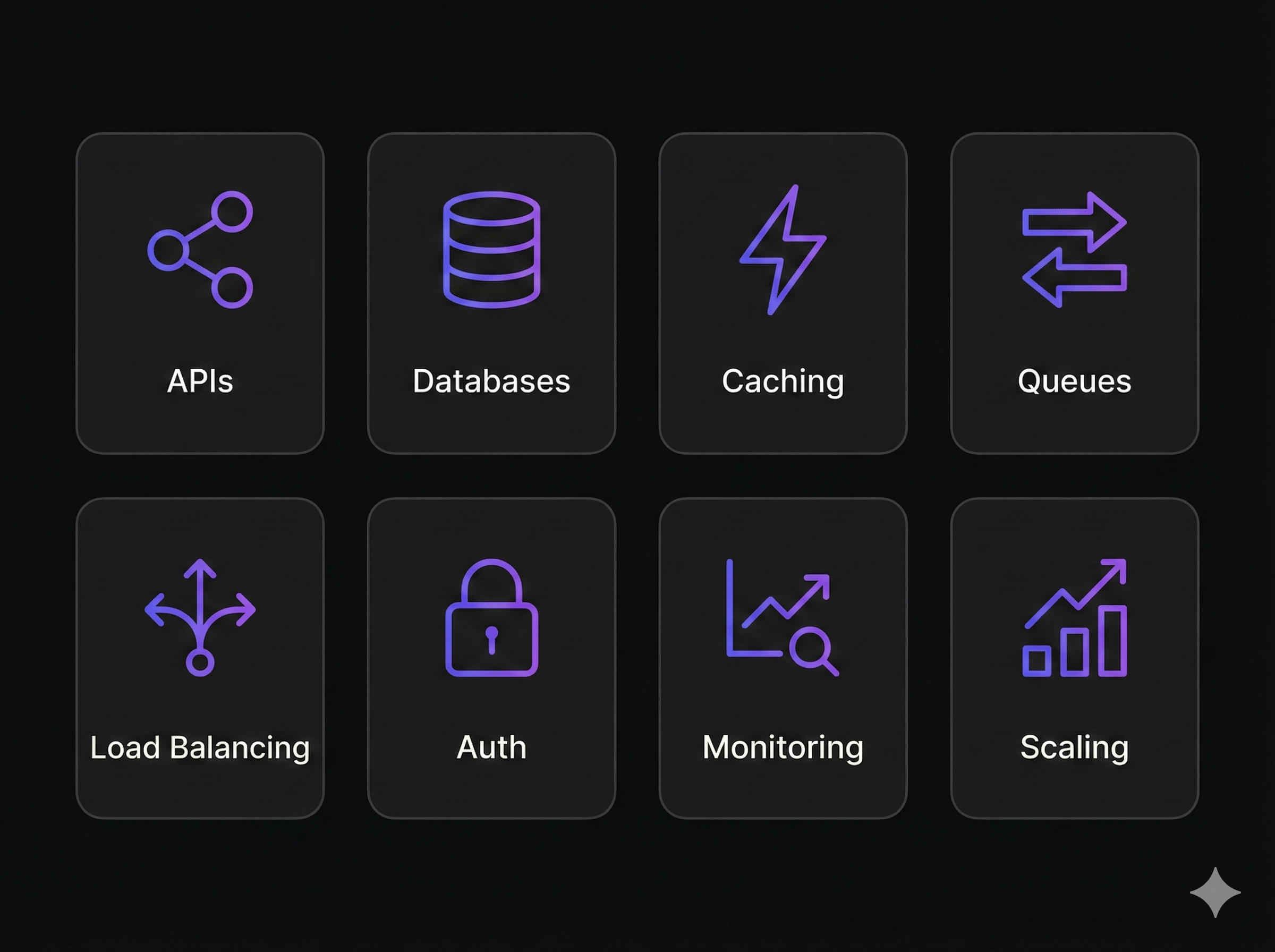
1. HTTP & APIs
- RESTful API design principles
- Request/response lifecycle
- Status codes and error handling
- Idempotency and retry logic
- API versioning strategies
- Rate limiting approaches
Interview scenario: "How would you design the API for a food delivery app?"
2. Databases & Storage
- SQL vs. NoSQL trade-offs (when to use each)
- Indexing strategies and query optimization
- Normalization vs. denormalization
- Sharding and partitioning
- Replication (master-slave, multi-master)
- CAP theorem in practice
Interview scenario: "How would you store user data for a social network with 500M users?"
3. Caching
- Cache-aside vs. write-through vs. read-through
- Cache invalidation strategies
- TTL (Time To Live) decisions
- Cache hierarchies (L1, L2, CDN)
- Cache stampede prevention
- Distributed caching (Redis, Memcached)
Interview scenario: "How would you reduce database load for a high-traffic e-commerce site?"
4. Load Balancing
- Layer 4 vs. Layer 7 load balancing
- Load balancing algorithms (round-robin, least connections, consistent hashing)
- Health checks and failover
- Sticky sessions vs. stateless design
- Global vs. regional load balancing
Interview scenario: "How would you distribute traffic across multiple data centers?"
5. Message Queues & Async Processing
- Queue vs. pub/sub models
- Message ordering guarantees
- At-least-once vs. exactly-once delivery
- Dead letter queues
- Backpressure handling
- Event-driven architecture
Interview scenario: "How would you process millions of photo uploads asynchronously?"
6. Authentication & Security
- Authentication vs. authorization
- Session-based vs. token-based auth
- OAuth 2.0 and SSO
- JWT tokens and refresh strategies
- API key management
- Rate limiting for security
Interview scenario: "How would you implement secure authentication for a mobile banking app?"
7. Scalability Patterns
- Horizontal vs. vertical scaling
- Database sharding strategies
- Microservices vs. monolith
- Service discovery
- Circuit breakers and fallbacks
- Auto-scaling strategies
Interview scenario: "Your API is getting 10x more traffic. How do you scale?"
8. Observability & Monitoring
- Logging best practices
- Metrics and dashboards
- Distributed tracing
- Alerting strategies
- Error tracking
- SLIs, SLOs, and SLAs
Interview scenario: "How would you detect and debug issues in a distributed system?"
How to Actually Prepare: A Science-Backed Approach
Here's where most engineers go wrong: they watch 20 hours of system design videos, feel confident, then freeze in the actual interview.
The problem? Passive learning doesn't work for system design interviews.
Why Traditional Courses Fail
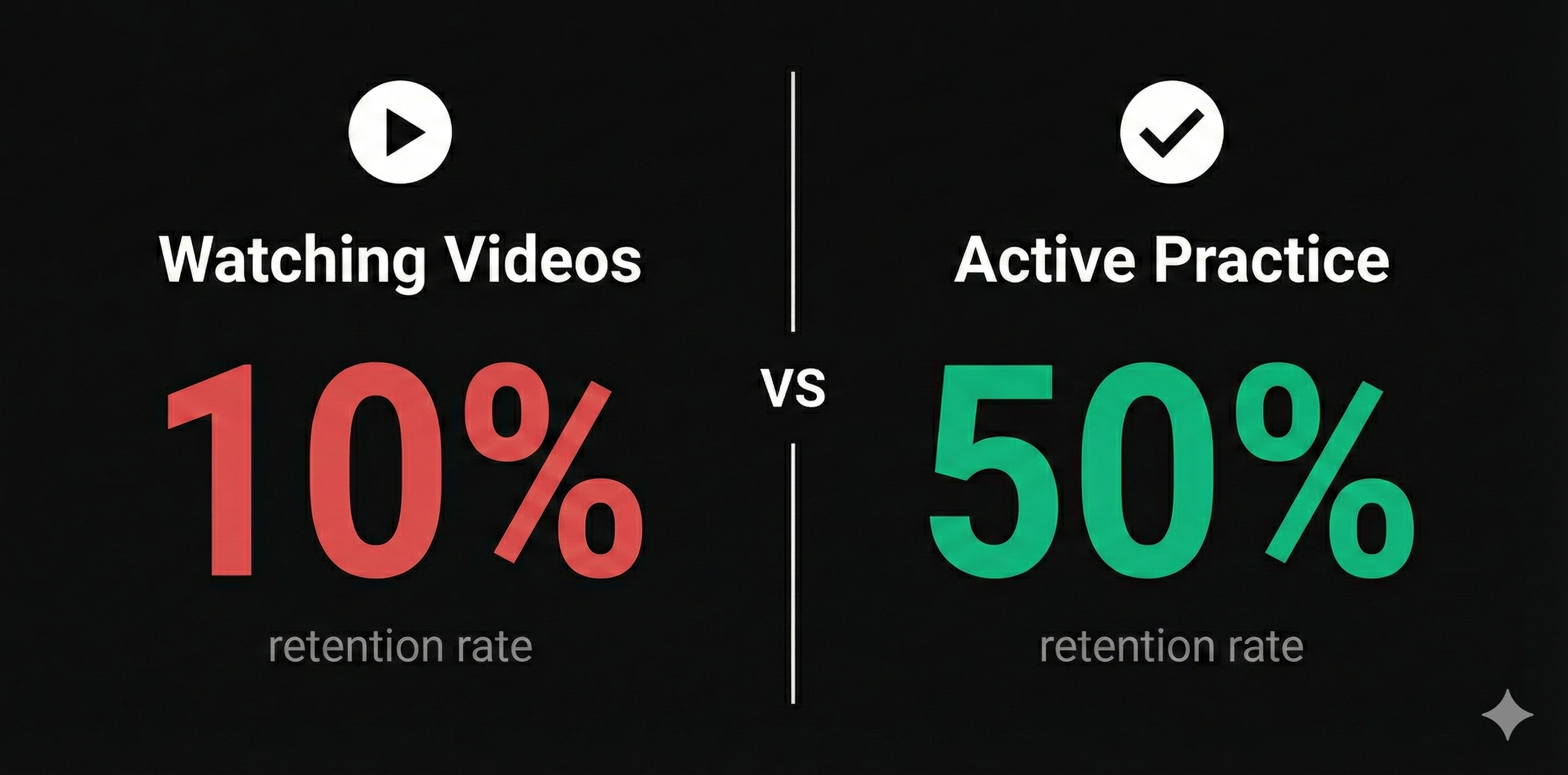
Research in cognitive psychology shows that active recall—forcing yourself to retrieve information—creates 50% stronger memory retention than passive review.
When you watch someone design Twitter, you think "Oh, I understand that." But when you're asked to design Instagram in an interview, your mind goes blank. You never practiced creating the design yourself.
The 10% Completion Problem
Most system design courses have completion rates below 10%. They're too long (8+ hours), too passive (just watching), and too disconnected from real practice.
The Training Approach (Not Cramming)
Think of system design interviews like a marathon. You wouldn't watch marathon videos for 8 hours the night before and expect to run 26 miles. You'd train daily for months.
The optimal preparation strategy:
Phase 1: Build Your Foundation (Weeks 1-4)
- Master the 8 building blocks above
- Practice active recall on each concept
- Do this daily in 5-10 minute sessions
- Focus: "Can I explain this concept under pressure?"
Phase 2: Component Practice (Weeks 5-8)
- Practice designing individual components
- "Design an API for X"
- "Design a caching layer for Y"
- "Design a database schema for Z"
- Focus: Small, specific challenges
Phase 3: Full System Design (Weeks 9-12)
- Tackle complete system design questions
- Practice the 45-minute interview format
- Record yourself and review
- Get feedback from peers or mentors
- Focus: Communication + trade-off discussion
The Power of Spaced Repetition
Instead of cramming all concepts in one weekend:
- Study Module 1 (HTTP/APIs) → Review 3 days later → Review 7 days later → Review 14 days later
- This spaced approach creates long-term retention
- By interview day, you can access concepts instantly under pressure
The Anatomy of a Great System Design Interview
Let's walk through a 45-minute system design interview so you know what to expect.
Requirements Clarification
Interviewer: "Design Instagram."
- Are we focusing on photo upload/viewing, or also stories, messages, and reels?
- What scale are we designing for? 100M DAU? 1B?
- What are our latency requirements? Real-time updates or eventual consistency?
- Are we designing mobile, web, or both?
High-Level Design
Sketch the main components:
[Mobile App] → [API Gateway] → [Load Balancer]
                                     ↓
                            [Web Servers (stateless)]
                                     ↓
                    ┌────────────────┼────────────────┐
                    ↓                ↓                ↓
              [Photo Service]   [Feed Service]   [User Service]
                    ↓                ↓                ↓
[S3/Blob] [PostgreSQL] [Redis Cache]Deep Dives
Interviewer picks components to pressure-test:
"How does your feed service handle 1M users viewing feeds simultaneously?"
Your response should cover:
- Pre-computed feeds vs. on-the-fly generation
- Fan-out on write vs. fan-out on read trade-offs
- Caching strategy (user-level, global)
- Database query optimization
Scalability & Wrap-up
"Your system is getting 10x traffic. What breaks first?"
Demonstrate bottleneck thinking:
- Database writes (solution: sharding)
- Photo storage (solution: CDN + distributed storage)
- Feed generation (solution: more aggressive caching)
Common Mistakes That Cost You the Offer
1. Jumping to Solutions Too Quickly
Fix: Always spend 5 minutes clarifying requirements.
2. Over-Engineering or Under-Engineering
Fix: Match complexity to scale. Ask "At what scale does this break?" and design for 10x that.
3. Not Discussing Trade-offs
Fix: For every decision, explicitly state the alternative and why you didn't choose it.
4. Not Communicating Your Thought Process
Fix: Think out loud. Interviewers want to see HOW you think, not just your final answer.
5. Claiming "This is the Best Solution"
There is no "best" solution in system design. Every choice has trade-offs.
Fix: Always acknowledge limitations of your design.
Company-Specific Preparation Tips
Different companies emphasize different aspects of system design interviews.
Meta (Facebook)
Focus: Scalability and real-time systems
Common questions: News feed ranking, messaging, live video
What they care about: Fan-out patterns, caching at scale, eventual consistency
Focus: Distributed systems and data structures
Common questions: Search indexing, MapReduce-style problems, distributed storage
What they care about: Consistency models, distributed algorithms, efficiency
Amazon
Focus: Scalability, cost optimization, and reliability
Common questions: E-commerce cart, inventory management, distributed databases
What they care about: CAP theorem trade-offs, eventual consistency, fault tolerance
Netflix
Focus: Media streaming and content delivery
Common questions: Video encoding, CDN strategy, recommendation systems
What they care about: Global distribution, adaptive bitrate, chaos engineering
Uber
Focus: Real-time systems and location services
Common questions: Ride matching, real-time location tracking, surge pricing
What they care about: Geospatial indexing, low-latency requirements, availability
Stripe
Focus: Reliability, security, and transactions
Common questions: Payment processing, fraud detection, API design
What they care about: ACID properties, idempotency, security
Resources: What to Study and Where
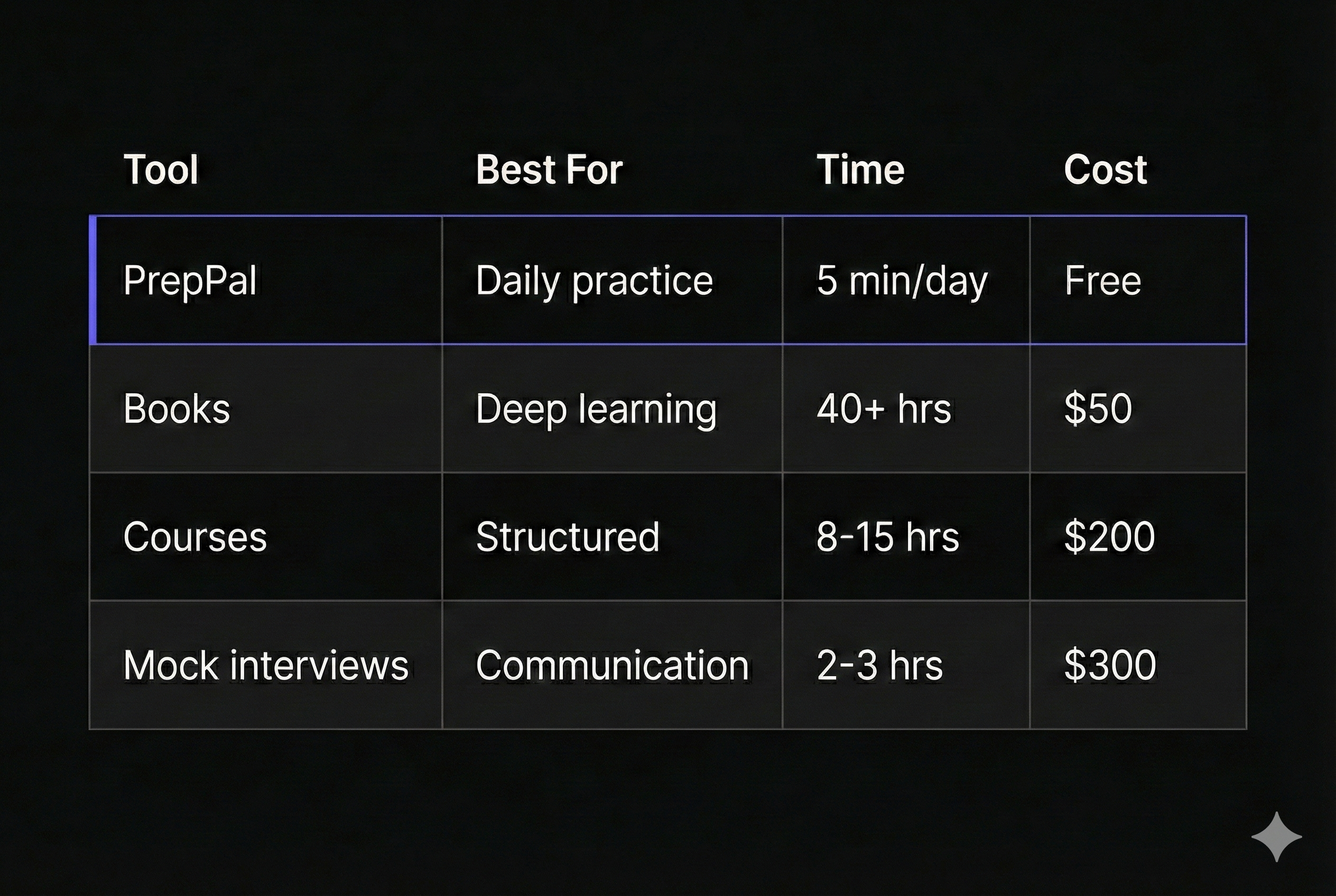
Books (Deep Understanding)
"Designing Data-Intensive Applications" by Martin Kleppmann
- The bible of system design
- 600 pages of deep technical content
- Best for: Understanding trade-offs and internals
- Time investment: 40+ hours
"System Design Interview" by Alex Xu (Volumes 1 & 2)
- Visual, easy-to-digest format
- Covers common interview questions
- Best for: Interview-specific preparation
- Time investment: 15-20 hours
Practice Platforms
PrepPal (Daily Active Recall Practice)
- Mobile-first app with 5-minute daily drills
- Active recall methodology (you practice, not watch)
- Spaced repetition algorithm tracks weak spots
- Free tier to start + $20/month Pro
Best for: Building foundational knowledge with daily consistency
Pramp (Free Mock Interviews)
- Peer-to-peer practice
- Good for communication practice
- Free
Excalidraw (Visual Design Tool)
- Simple browser-based diagramming
- Fast to use, clean diagrams
- Free
Engineering Blogs (Real-World Systems)
- Meta Engineering Blog (engineering.fb.com) — How Meta actually builds at scale
- Netflix Tech Blog (netflixtechblog.com) — Microservices architecture
- Uber Engineering (eng.uber.com) — Real-time systems and geospatial
- AWS Architecture Blog — Cloud architecture patterns
Your 30-Day Preparation Plan
Here's a realistic timeline if you're interviewing in 30 days.
Week 1: Foundation Building
Daily time commitment: 30-60 minutes
- Monday-Wednesday: HTTP & APIs — Read about REST principles, practice explaining API design
- Thursday-Friday: Databases — Study SQL vs. NoSQL trade-offs, draw schema diagrams
- Weekend: Caching — Deep dive on cache strategies, watch videos on cache invalidation
Week 2: Core Components
Daily time commitment: 45-90 minutes
- Monday-Tuesday: Load Balancing & Scaling
- Wednesday-Thursday: Message Queues
- Friday-Sunday: Mini System Designs (URL shortener, rate limiter, cache service)
Week 3: Full System Practice
Daily time commitment: 60-90 minutes
- Monday: Design Instagram (45-minute timer, record yourself)
- Tuesday: Design Twitter
- Wednesday: Design Uber
- Thursday: Design YouTube
- Friday: Design WhatsApp
- Weekend: Review recordings, identify weak spots
Week 4: Interview Simulation
Daily time commitment: 60-120 minutes
- Monday-Wednesday: 2-3 mock interviews (Pramp or friends)
- Thursday-Friday: Deep dives on weak topics
- Weekend before interview: Light review, get good sleep
Frequently Asked Questions
"How long does it take to prepare?"
Minimum: 4 weeks of focused daily practice
Comfortable: 8-12 weeks
Ideal: Ongoing practice (stay interview-ready)
"Do I need to know specific technologies?"
No. Interviewers care about concepts, not brand names. Say "serverless functions" instead of "AWS Lambda." The exception: if interviewing at AWS, Azure, or GCP, know their service landscape.
"Should I memorize solutions?"
No. Instead, internalize the building blocks and practice combining them creatively. Think of it like LEGO: You don't memorize complete builds. You learn what pieces do, then build whatever is needed.
"What if I haven't worked with distributed systems?"
Most engineers haven't built systems at Google-scale. That's okay. What matters is: Can you reason about scale? Do you understand fundamental trade-offs? Can you learn and apply concepts?
"What if the interviewer asks about something I don't know?"
Say: "I'm not deeply familiar with [X], but I understand we need [capability]. Could I design using a general approach and you can tell me if [X] fits?" This shows humility and problem-solving.
Conclusion: Your Action Plan Starts Today
System design interviews are learnable. You don't need a PhD in distributed systems or 10 years at Google. You need:
- Understanding of building blocks (APIs, databases, caching, queues)
- Practice applying them (active recall, not passive watching)
- Communication skills (thinking out loud, discussing trade-offs)
- Consistency (daily practice beats weekend cramming)
Start here:
This week:
- Pick one building block (start with HTTP & APIs)
- Study for 30 minutes
- Practice explaining it out loud
- Do 5 minutes of active recall daily
Remember: Everyone fails system design interviews at first. The difference between those who eventually succeed and those who don't is simply persistence and smart practice.
Your interviews at Meta, Google, Amazon, or wherever you're aiming are absolutely achievable. Start training today.
Ready to Start Practicing?
Try PrepPal's free tier to start building your system design foundation with 5-minute daily drills. No credit card required.